


Looking for free crochet patterns for baby blankets? You're in the right place. Below you'll find crochet baby blanket patterns free to make, advice on the best yarn for a baby blanket, and our full step-by-step tutorial for crocheting a basic baby blanket from scratch.
Crocheting a baby blanket for a new arrival is a rewarding experience and a wonderful project for crocheters of every skill level. Whether you want to follow a pattern exactly or learn the technique so you can make your own from scratch, this guide covers both.
Free Crochet Baby Blanket Pattern
Our Basic Baby Blanket pattern, included in full further down this page, is completely free to follow — no download required. It's made with just two basic stitches, so it's a great starting point if you're newer to crochet.
More Crochet Baby Blanket Patterns to Try
Once you're ready for more variety, here are a few paid patterns worth a look, each priced individually below.
Crocheted Baby Blanket Pattern
A cozy blanket worked with two strands of Anti-Pill worsted-weight yarn held together for extra softness and durability. Finished size: 27.5 x 36.5".
Reversible Baby Blanket Pattern
A two-sided blanket originally designed with a soft DK sport-weight yarn, giving you a different look on each face.
Baby Blanket Squared Pattern
A bright, cheerful blanket with a simple stitch design that works up quickly. Finished size: 40" square. Easy crochet.
Baby Swirls Blanket Pattern
A colourful swirl design worked across four shades of Mary Maxim Baby Value yarn, for a blanket with real visual movement.
Best Yarn for a Baby Blanket
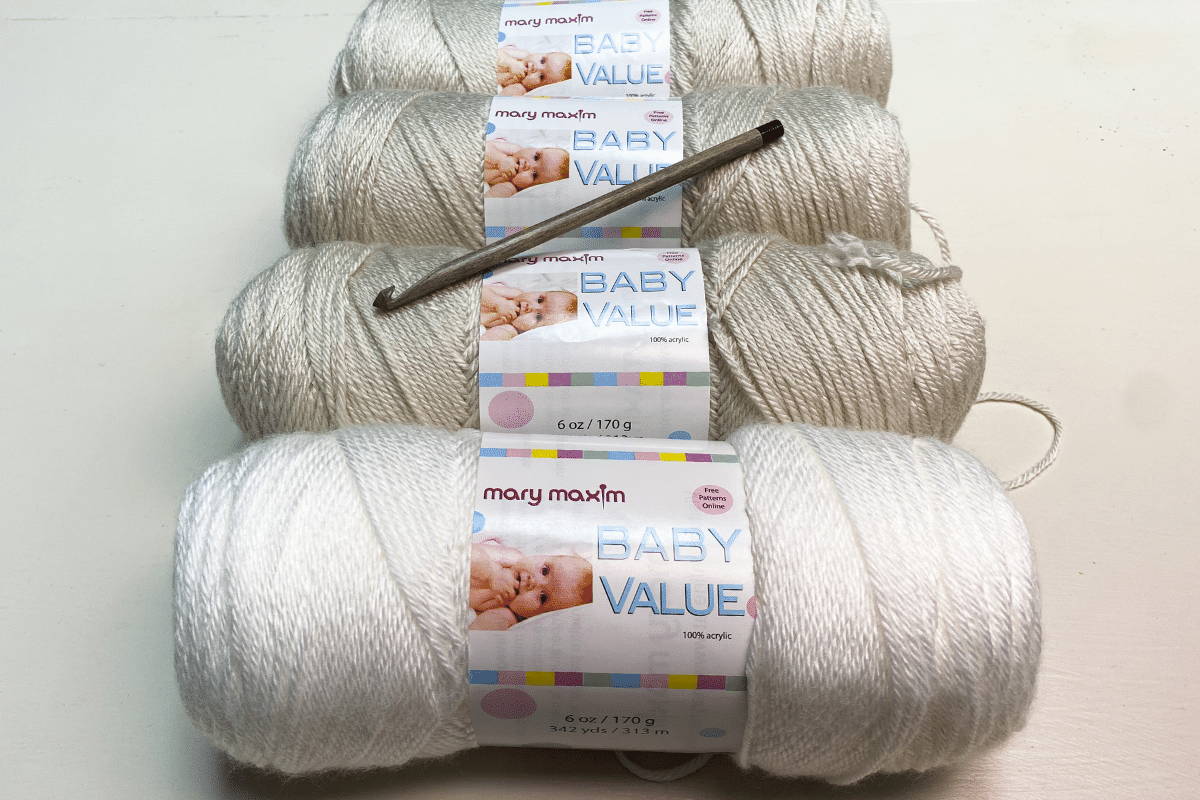
The right yarn depends on how the blanket will actually be used, but a few fibre types come up again and again for baby projects.
Acrylic and polyester yarns are notable for their easy-care nature — they're often machine washable and hold up well over time. Yarns like this have a unique soft feel and are great for baby items, though quality varies, so screen out anything scratchy and stick to a mild acrylic or polyester blend. Before committing, make a gauge swatch and run it through a wash-and-dry cycle to see how it'll actually wear.
Cotton yarn is soft, breathable, and welcoming. Most blankets made with cotton feel cool and crisp, which makes it a good choice if you're worried about baby overheating. It's also durable and easy to care for.
Common Baby Blanket Sizes
Baby blankets are usually sized to their intended use, from a small, huggable lovey up to something closer to a full-size throw.
Preemie
The smallest common size, at 26" wide by 34" long. With a yarn offering around 283 meters per ball, plan on roughly two to three 5-oz skeins, or about 724 yards, depending on your tension.
Newborn
A mid-sized newborn blanket typically measures 30" square, or 30" x 34" for a rectangular version. Plan on around two to three 5-oz balls of yarn.
Toddler
The largest of the common baby blanket sizes, at roughly 36" x 44" — about half the size of a full throw. Expect to need up to four 5-oz skeins.
Are Crochet Blankets Safe for Babies?
Crochet baby blankets make a wonderful gift for newborns and expecting parents, but use any handmade baby item with caution, especially for a baby under one year old. All baby blankets, handmade or not, should be used under supervision. Crochet items are naturally breathable, which helps, but isn't a guarantee on its own. Health guidance in both Canada and the US advises against anything soft in a baby's crib, and sleep sacks are the current preferred option for crib sleeping.
The same caution applies to a car seat, stroller, or swing — make sure anything you use lines up with local safety guidelines and car seat instructions. Nothing, including a blanket, should sit between a baby and the car seat itself; a dedicated car seat blanket that doesn't interfere with the restraints is a safer choice.
Pay attention to loose ends too. Make sure yarn ends are tied off, woven in, and trimmed short to avoid entanglement risk, and skip buttons, beads, or other small embellishments on anything meant for a baby, since they can work loose and become a choking hazard.
What You'll Need to Crochet a Baby Blanket
Beyond yarn and a hook, you'll want a tapestry needle and stitch markers on hand. Hook size matters more than it might seem: a hook sized 2-3 times larger than what's recommended on the yarn label gives you looser stitches and more drape, while a smaller hook tightens things up, which works well if you're crocheting an image into the blanket or working a mosaic pattern. Baby blankets shouldn't be so stiff they feel rigid, or so loose that little fingers and toes can work through the stitches.
How to Crochet a Basic Baby Blanket: Step-by-Step Tutorial
This is a completely free pattern, no download required, made with only two basic crochet stitches: the half double crochet and the chain stitch.
What You'll Need
- Yarn: Medium Weight (Size 4) — Mary Maxim Baby Value Yarn, MC Cottonwood (3 skeins), CC White (1 skein)
- Crochet Hook: Size J-10 (6.00 mm)
- Tapestry needle
- Scissors
Stitch Guide
ch – chain stitch | st – stitch | sl st – slip stitch | hdc – half double crochet | blo – back loop only
To finish off: leave a 5-6 inch tail before cutting the yarn, then pull the loop on your hook through until the yarn end passes through completely, and tighten gently.
Gauge Swatch
Achieving gauge isn't essential for this project, but it's good practice: 14 sts & 10 rows = 4" measured over the pattern using the suggested hook, or any hook that gives you the same result. If your gauge runs big, the finished blanket will be larger than expected and you may run short on yarn — size down your hook. If it runs small, size up.
To swatch: chain 21, then Half-Double Crochet in the third chain from the hook and in each chain across, turn. Row 2: chain 2 (counts as the first hdc throughout), hdc in the back loop only of each stitch across, turn. Repeat row 2 for 10 more rows, then measure.
When worked as written, the finished blanket measures 36" x 48".
Simple Baby Blanket Pattern Instructions
Using Main Color, chain 121.
Row 1: Half-Double Crochet in third ch from hook and in each ch to end, turn.
Row 2: Ch 2 (counts as first hdc now and throughout pattern), hdc in blo of next st, and in each rem st to end, turn.
Repeat row 2, changing colors as follows:
Rows 3-10: MC | Rows 11-14: CC | Rows 15-16: MC | Rows 17-20: CC | Rows 21-30: MC | Rows 31-32: CC | Rows 33-42: MC | Rows 43-44: CC | Rows 45-54: MC | Rows 55-56: CC | Rows 57-66: MC | Rows 67-68: CC | Rows 69-78: MC | Rows 79-80: CC | Rows 81-90: MC | Rows 91-94: CC | Rows 95-96: MC | Rows 97-100: CC | Rows 101-110: MC
Tips for Making the Basic Baby Blanket
This is a simple, forgiving pattern. The half-double crochet stitch is versatile and interchangeable — if you're more comfortable with single or double crochet, feel free to swap it in and make the pattern your own. We'd avoid substituting in treble crochet specifically, since it leaves noticeably larger gaps between stitches.
Sizing up the hook here is intentional: it increases drape, which is what gives this blanket its soft, close-to-the-skin feel when cuddled.
If you'd like a smaller blanket, reduce the starting chain count, and remember to cut some of the row repeats in the middle of the blanket to match.
On Row 1, the two skipped chains count as your first half double crochet. This keeps the edge of your blanket straight, but don't forget to work into those chain stitches when you reach them on the next row — a common beginner error that causes unintentional decreasing. For a closer look at the stitch itself, this half double crochet video walkthrough covers it step by step.
On Row 2, you're working into the back loop only, which is what creates the ridged texture that gives this blanket its beautiful drape. Normally you'd work through both loops of the stitch below; here, work only through the back loop, visible as the loop farthest from you at the top of each stitch.
How to Change Colour When Crocheting
Always change colour on the last stitch of the row before the colour change — for this pattern, that's the chain-2 that counts as the first hdc. Yarn over, insert your hook into the last chain of that stitch, and draw up a loop in the current colour. Then yarn over again and draw the new colour through all the loops on your hook to complete the switch. For a visual walkthrough, this colour-changing tutorial covers the technique in more detail.
How to Weave in Ends
Finish off your yarn by pulling it through the last loop on your hook. Thread a tapestry needle with the tail and weave it through the fabric, ideally across about four stitches and four rows, without crossing into a different colour section. If you're working a short contrast-colour section of just two rows, weave through those two rows only. Keep your tension even as you weave — too tight, and the fabric will pucker. Trim the excess, and you're done.

